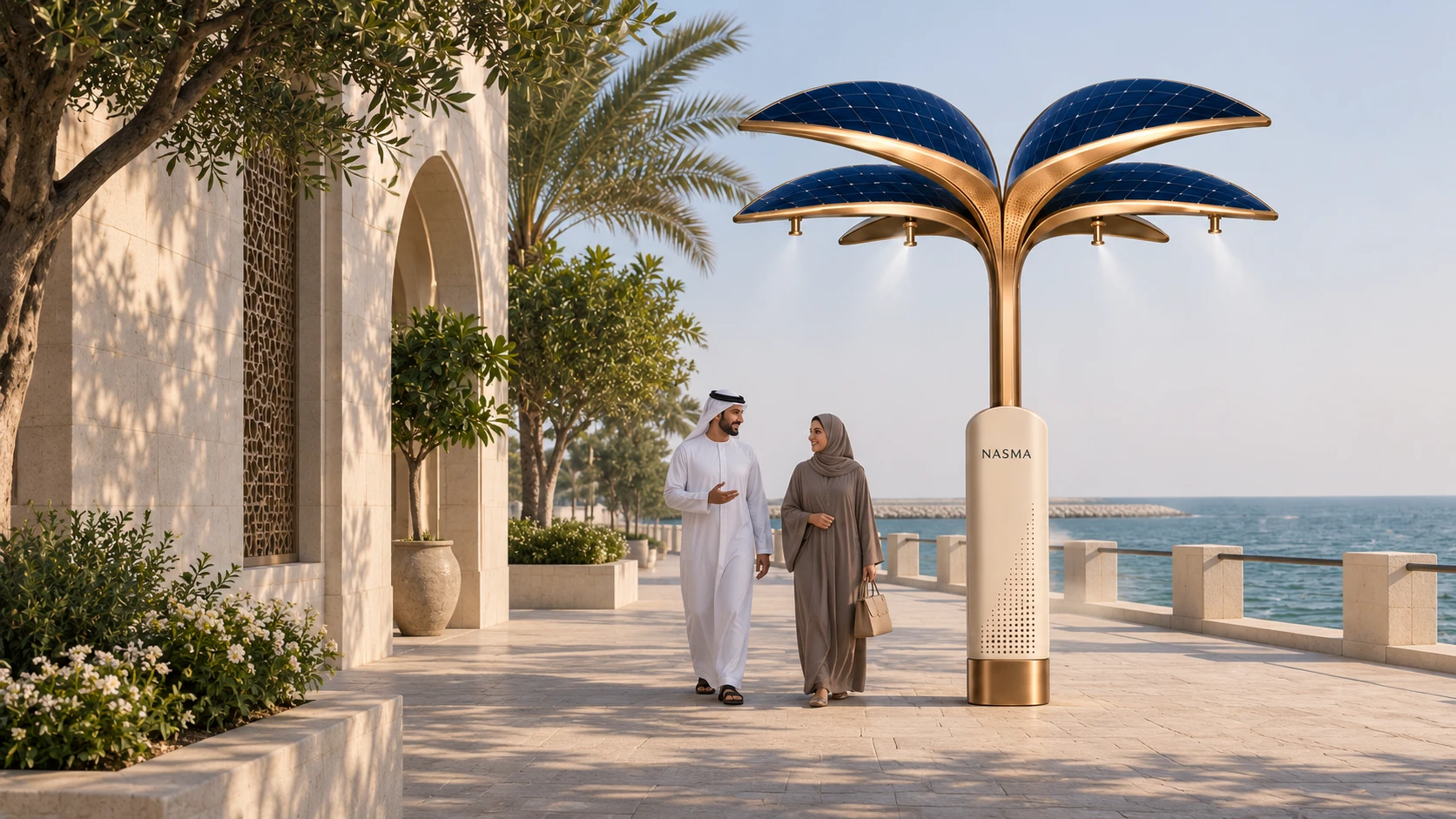
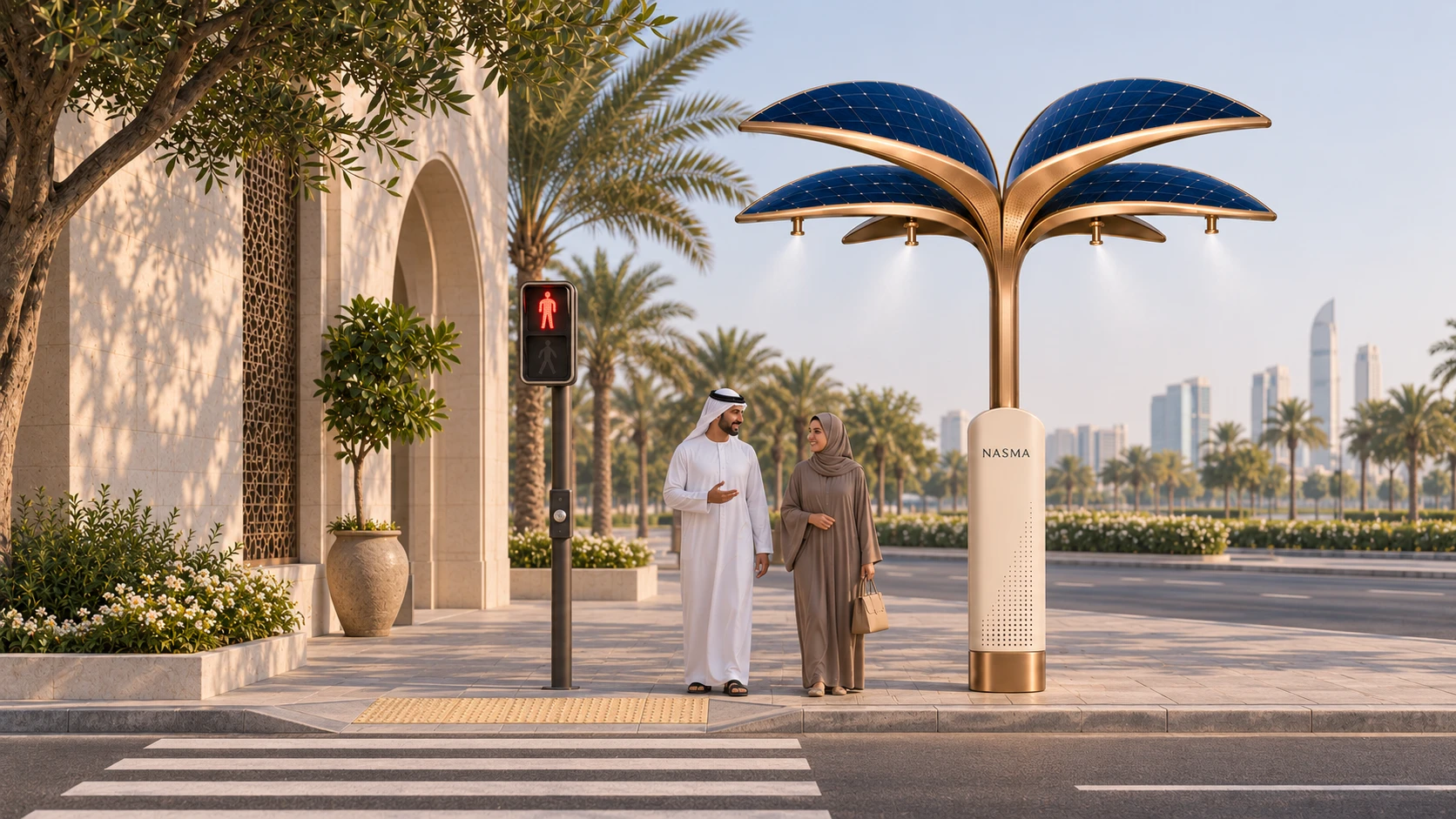
The wait at a crossing. A walk along the waterfront. A moment shared outdoors. In hot-climate cities, these everyday experiences deserve a more thoughtful response.
NASMA explores a new approach: recovering water from air, delivering carefully controlled cooling and connecting each installation through intelligent infrastructure.
Under technical development in the United Arab Emirates.
Water from airSolar-assistedIntelligently connectedSafety by design
The NASMA concept
A natural idea. An intelligent system.
Atmospheric water generation, validated treatment and demand-led cooling—conceived as one architectural installation.
Concept visualization
Capture
Humidity becomes a resource.
Ambient air enters the atmospheric water generation module.
A shared technology platform, shaped around the way people move through a place.
Concept visualization
NASMA Crossing
At the crossing
Cooling while the city waits.
A crossing-adjacent installation designed to respond to pedestrian queues and traffic-signal phases.
Intelligent pedestrian detection
Signal-aware waiting-zone cooling
Solar-assisted power and connected monitoring
Independent pedestrian and misting safety interlocks
Concept visualization
NASMA Walk
Along the path
A sculptural pause along the way.
An independent architectural installation for communities, parks, promenades and outdoor destinations.
Occupancy-responsive cooling
Local microclimate sensing
Centralized monitoring and maintenance
Modular infrastructure for connected destinations
NASMA Intelligence
Every tree connects. Every insight matters.
The planned AI platform is part of the core prototype architecture, connecting local sensing with a shared view of water, energy and maintenance.
Explore a connected destinationConcept demonstration · Simulated
Illustrative urban network
NNASMA Intelligence
Waterfront
Waterfront · Illustrative response
Standby
Low occupancy. The platform recommends conserving water while monitoring local conditions.
Simulated demand20%
Operating priorityConserve resources
This interface illustrates proposed behavior. It is not connected to deployed installations or live AI models.
Understand demand
Privacy-conscious occupancy and dwell sensing without facial recognition.
Anticipate comfort
Forecast near-term demand from weather, activity patterns and operating data.
Coordinate resources
Support water-generation schedules, energy use and available reserves across the network.
Care for the network
Identify abnormal performance and prepare maintenance recommendations for human review.
Local safety always wins.AI cannot override hygiene, electrical, misting or pedestrian safety interlocks.
Architectural identity
A new kind of urban landmark.
Inspired by the palm. Designed for the public realm.
Sculptural photovoltaic fronds, discreet mist outlets and an integrated equipment enclosure bring the system into one recognizable form.
Solar generation supports operation. Mains electricity remains part of the architecture.
Concept visualization
Technology & responsibility
Ambitious by design. Measured by evidence.
Engineering integrity is the starting point. Performance, safety and environmental impact must be established through testing.
Water generation
Compressor-based atmospheric water generation is the primary prototype approach. Desiccant-based capture remains a parallel research and development track.
Resilient power
Solar-assisted generation with mains support. Water yield and energy consumption will be evaluated under relevant local conditions.
Modular operations
Serviceable modules, remote monitoring and AI-supported fault detection are intended to simplify maintenance and inform future scaling.
Public health is an engineering requirement
Water quality and aerosol hygiene are central to NASMA’s development. Public misting must not take place before appropriate water-treatment validation, safety testing and regulatory acceptance.
A multi-barrier treatment and controlled storage system must be validated as a whole. Ultraviolet treatment alone does not guarantee safe misting. Local controls must stop operation whenever conditions are unsuitable.
Pilot development
Build. Validate. Then take the next step.
NASMA is seeking suitable partners for a controlled pilot. These are proposed development stages, not completed milestones.
Stage 1
Engineering & prototype
Develop and test water generation, treatment, electronics and working AI-supported monitoring.
Stage 2
Controlled demonstration
Validate hygiene, electrical safety, cooling performance and reliability. Compare AI-guided operation with conventional controls.
Stage 3
Pilot installation
Work with a suitable host toward a carefully controlled real-world demonstration, subject to required approvals.
Stage 4
Scalable infrastructure
Explore a connected network informed by evidence from the prototype and pilot.
Partnerships
Let’s shape the future of urban comfort.
We are exploring partnerships to advance engineering, validate the technology and demonstrate intelligent outdoor comfort infrastructure.
Government & municipalities · Urban developers · Community operators Smart-city initiatives · Research & engineering · Infrastructure investors
About outdoor cooling
Understanding NASMA.
What is NASMA developing?
NASMA is developing an outdoor cooling and urban comfort concept in the United Arab Emirates. It combines atmospheric water generation, solar-assisted electrical power, controlled misting and an AI-supported management platform for pedestrian spaces.
How does atmospheric water generation support cooling?
An atmospheric water generator recovers moisture from ambient air. NASMA proposes treating and storing that water in a controlled system for localized evaporative cooling. Water yield, energy use and cooling performance depend on conditions and must be measured during development.
Where could NASMA be used?
NASMA Crossing is intended for pedestrian crossing waiting areas. NASMA Walk is designed for pedestrian-only environments such as community walkways, parks, waterfront promenades and outdoor destinations. Site suitability and approvals would be assessed before any public pilot.
Is NASMA focused only on the UAE?
NASMA is being developed in the UAE, with a wider vision for pedestrian comfort across the Gulf Cooperation Council (GCC): the United Arab Emirates, Saudi Arabia, Qatar, Kuwait, Bahrain and Oman. We welcome discussions with potential pilot hosts, urban developers and engineering partners across these countries.
Different Gulf locations have different humidity, heat, wind and maintenance conditions. Suitability would need local evaluation and approvals; regional interest does not imply existing installations or proven performance in each country.
Is NASMA fully solar-powered or available to buy?
NASMA is solar-assisted and grid-backed, not claimed to be fully off-grid. It is under technical development and is seeking engineering and pilot partners. It is not yet presented as a certified, commercially deployed misting system.
Start a conversation
A better outdoors starts with an idea.
Discuss a pilot site, engineering collaboration or development partnership.